



Most employer plans end the day your employment does. Here is what that means, what your options are, and how to make sure your family is never left without protection.
- What is employer-provided life insurance?
- What actually happens when you leave
- Your three options after leaving
- Comparing your options side by side
- The coverage gap nobody plans for
- What to do, and when
- A few questions we hear often
- What makes an individual policy worth having
- You deserve a policy that belongs to you
- 9 min read
- For families and estate planners
- Updated 2025
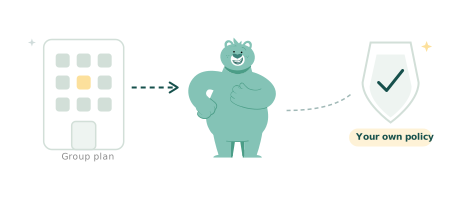
What is employer-provided life insurance?
Many companies offer life insurance as part of their benefits package. This is called group life insurance, and it works differently from a personal policy in a few important ways.
With a group plan, your employer negotiates a contract with a carrier and extends coverage to employees, often at little or no cost to you. The coverage amount is usually a fixed multiple of your annual salary, something like one or two times what you earn per year.
It is a genuinely valuable benefit. But it comes with a structural limitation that most people never think about until it is too late.
- The key detail
Group life insurance is tied to your employment. The policy belongs to the employer, not to you. That means when your employment ends, so does the coverage, usually on your last day of work or at the end of that month.
57%
of U.S. workers have employer-provided life insurance
1–2x
typical coverage: 1 to 2 times your annual salary
~30
days is the typical window to act after leaving
What actually happens when you leave
Whether you resign, get laid off, or retire, the result is the same: your group coverage stops. You do not get to take the policy with you as-is.
Most people assume their health insurance situation applies here too, and that they can simply keep paying to stay covered. Group life insurance does not work that way by default. You have to take deliberate action, and you have a limited window to do it.
The good news is that there are options available. Two of them come directly from your employer plan, and a third, the one most financial professionals recommend, involves getting a personal policy of your own.
- Worth checking before you leave
Review your benefits documents or speak with HR before your last day. Each employer plan has different rules, deadlines, and options. Knowing what is available helps you avoid a coverage gap entirely.
Your three options after leaving
When employer coverage ends, you have three paths available. Understanding what each one involves will help you choose the one that fits your situation best.
Option 1
Convert the policy
Most group plans include a conversion right. This lets you convert your group coverage into an individual permanent policy without a new medical exam. The downside is that converted policies tend to be whole life, and the premiums can be significantly higher than what you would pay by shopping independently.
Option 2
Port the coverage
Some plans allow portability, meaning you can keep the same group policy active by taking over the premium payments yourself. Portability is only available when the original plan includes this feature, and the rates are generally not competitive compared to individual market options.
Option 3 (Recommended)
Apply for your own individual policy
This is the path most financial professionals recommend, especially if you are in good health. An individual policy belongs to you, not your employer. It travels with you through every job change, career shift, or life transition. Coverage amounts can be tailored to your actual needs, and term life premiums are often more affordable than what you would pay to convert or port a group plan.
The best time to apply is while your health is on your side. A 30- or 35-year-old in good health can lock in a low premium for 20 to 30 years, regardless of what changes in their career later.
- Why most people prefer Option 3
Converting or porting a group plan keeps you covered in the short term, but neither option gives you long-term control. An individual policy lets you choose the right amount, the right type, and the right carrier based on your family’s actual needs, not what your employer happened to negotiate.
Comparing your options side by side
Each option has its tradeoffs. Here is a clear look at how they stack up across the things that matter most.
| Feature | Conversion | Portability | New individual policy |
|---|---|---|---|
| Medical exam required | No exam | No exam | Sometimes |
| Coverage amount flexibility | Limited | Limited | Full control |
| Policy type options | Whole life only | Same as group plan | Term, whole, IUL |
| Premium competitiveness | Often high | Often high | Market rate |
| Policy stays with you long-term | Yes | Check terms | Yes |
| Coverage continues if you change jobs again | Yes | Depends on plan | Yes, always |
| Typical application window | 31 days from job end | 31 days from job end | Any time |
The coverage gap nobody plans for
People change jobs more often than ever. A career shift, a startup opportunity, a move to freelance work, or a brief period of unemployment are all normal parts of modern working life. Each one of those transitions creates a moment where life insurance coverage can quietly disappear.
The risk is not dramatic. It is a quiet gap between the day your employer coverage ends and the day a new policy goes into effect. Most of the time nothing happens during that window, but a policy exists precisely because we cannot predict when something might.
Why group coverage was never meant to be permanent
Group life insurance is a workplace benefit, not a financial plan. It is offered as part of a compensation package, not because it is the right amount for your family or the right type for your situation.
Most group plans provide coverage equal to one or two times your annual salary. For a family with a mortgage, young children, and other financial responsibilities, that amount is often far below what would actually be needed.
An individual policy lets you close that gap deliberately, with a coverage amount that reflects your life, not your job title.
What to do, and when
The timeline matters here. Group plan options are time-sensitive, and waiting too long can close doors that were available to you.
1
Before your last day
Request your benefits summary from HR. Confirm whether your plan includes a conversion right, a portability option, or both. Note the exact deadline for each, usually 31 days from your final day of employment.
2
Within the first two weeks
Begin the process of comparing individual policies. Even if you plan to use the conversion or portability option as a bridge, having a personal policy in place gives you more control and typically better long-term value.
3
Submit your application
Once you choose a policy, submit the application. Many term life policies can be approved quickly, and some no-exam options can issue coverage within days of applying.
4
Confirm your new coverage is active
Before your group plan lapses, confirm that your new individual policy is in force. A brief overlap is fine. What you want to avoid is any window where no coverage is active at all.
A few questions we hear often
My new employer will provide coverage. Do I still need my own policy?
It depends on how much coverage your new employer offers and how long you plan to stay. Group plans are tied to your job. If you leave again, the same situation repeats. An individual policy travels with you no matter where your career takes you.
What if I have a health condition? Can I still get coverage?
Possibly, yes. The conversion option from your group plan exists specifically for this situation, since no medical exam is required. However, rates will be higher. If you are in good health, applying for a new individual policy is usually the better financial choice.
How much individual coverage should I get?
A common starting point is 10 to 12 times your annual income. This accounts for lost earnings, debt, everyday expenses, and future goals like a child’s education. Your specific number depends on your household, your debts, and who depends on your income.
Is term life or whole life the right choice after leaving a job?
For most people in their 30s or 40s who want straightforward, affordable protection, term life is the standard recommendation. It provides a high coverage amount at a low cost for a defined period. Whole life and other permanent options make sense in specific situations, and a good advisor can help you figure out which fits your goals.
- Good to know
This content is educational and is not tax or financial advice. For guidance specific to your situation, speak with a licensed insurance professional or financial advisor.



What makes an individual policy worth having
Not all individual policies are equal. When shopping for coverage, these are the things that genuinely matter.
- The carrier has a strong financial strength rating, which reflects their ability to pay claims reliably.
- The coverage amount matches your household's actual financial picture, not just a round number.
- The premium is fixed for the length of the term, so there are no surprises down the road.
- The policy includes a conversion option, so you can move to permanent coverage later if your needs change.
- The application process is clear and the timeline is reasonable, especially if you are trying to avoid a coverage gap.
- You reviewed more than one carrier before deciding, so you know you are getting a competitive rate.
- Financial strength
- Industry longevity
- Claims reliability
You deserve a policy that belongs to you
Ozzo reviews carriers based on financial strength, industry track record, and claims reliability, then lets you compare your top options side by side. No pressure. No guesswork.
Takes about 2 minutes. No exam required to get started.
- Share This Article