



For most people, naming a spouse or child directly is perfectly fine. But in certain situations, a trust gives you a level of control, protection, and precision that a name alone simply cannot provide.
- What a trust actually is
- The three people involved in every trust
- The main types of trusts used with life insurance
- How the money actually flows
- When a trust makes the most sense
- Trust vs. naming a person directly: a clear comparison
- How to set this up, step by step
- Questions we hear often
- Getting the policy right matters just as much
- Start with the right policy and the right guidance
- 9 min read
- For families and estate planners
- Updated 2025
What a trust actually is
A trust is a legal arrangement where one person, called the grantor, transfers assets to a separate legal entity, the trust itself, for the benefit of one or more other people, called the beneficiaries. A trustee is appointed to manage those assets and follow the instructions written into the trust document.
Think of it as a set of rules placed around money. Instead of handing someone a check and hoping they spend it wisely, a trust lets you decide in advance how the money gets distributed, when it gets distributed, and under what conditions.
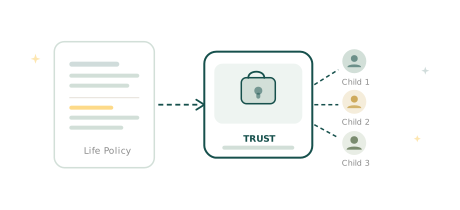
When applied to life insurance, the trust becomes the beneficiary of the policy. The insurance payout goes into the trust, and the trustee then distributes the funds according to whatever terms you have put in place.
- A useful way to think about it
Naming a person as your beneficiary says: “Give this person the money when I am gone.” Naming a trust says: “Give this money to a managed account with specific instructions, so it reaches the right people in the right way, at the right time.”
The three people involved in every trust
Every trust has the same three roles, regardless of how simple or complex the arrangement is. Understanding each one makes the whole structure much easier to follow.
| Role | Who they are | What they do |
|---|---|---|
| Grantor | You, the policy owner | Creates the trust, funds it with the life insurance policy, and writes the instructions that govern how assets are managed and distributed. |
| Trustee | A trusted adult, a professional trustee, or a bank trust department | Manages the trust assets after the policy pays out. Follows the instructions in the trust document. Has a legal obligation to act in the best interest of the beneficiaries. |
| Beneficiary | Your children, family members, or other designated recipients | Receives distributions from the trust according to the terms you have set. Does not control the assets directly unless the trust specifies otherwise. |
In many family situations, the grantor and the trustee are different people, by design. The grantor sets the rules; the trustee enforces them. This separation is what gives the arrangement its structure and its protection.
- Who should be your trustee?
Choose someone financially responsible who you trust completely, since they will have legal authority over how funds are distributed. Many families use a sibling, close friend, or professional trustee. For larger policies, a bank trust department or estate attorney can serve this role for a fee.
The main types of trusts used with life insurance
Not all trusts work the same way, and different situations call for different structures. Here are the types most commonly used alongside a life insurance policy.
Most common
Revocable living trust
You set this up during your lifetime and can change it, add to it, or dissolve it at any time. When the policy pays out, the funds flow into the trust and are distributed according to your instructions. This is a flexible, widely used option for families who want organized estate planning without the complexity of irrevocable structures.
Estate planning
Irrevocable life insurance trust (ILIT)
This trust is specifically designed to hold a life insurance policy. Once established, you cannot easily change it or take it back. In exchange, the policy’s death benefit may be excluded from your taxable estate, which can be meaningful for larger estates. The trust owns the policy and is the named beneficiary.
Minor children
Testamentary trust
This trust is created through your will and only comes into effect when you pass away. It does not exist during your lifetime. When combined with a life insurance policy, it provides a structured way to hold and distribute funds for minor children until they reach an age you specify, such as 25 or 30.
Special needs
Special needs trust
Designed for beneficiaries who receive government benefits such as Medicaid or Supplemental Security Income. A direct life insurance payout could disqualify them from those programs. A special needs trust lets the beneficiary benefit from the funds without affecting their eligibility for assistance.
How the money actually flows
The mechanics are straightforward once you see them laid out. Here is what happens from the moment a claim is filed to the moment your beneficiaries receive funds.
The path from policy to beneficiary
Step 1
Policy pays out to the trust
Step 2
Trustee receives and manages the funds
Step 3
Distributions follow your written instructions
The carrier sends the payout directly to the trust, not to any individual. The trustee then manages that money according to the trust document. Distributions can be structured in any number of ways: a monthly allowance, a lump sum at a specific age, funds released for education or housing, or a combination of all of these.
None of this requires going through probate. The money bypasses the court process entirely and reaches your beneficiaries faster and more privately than if it had passed through your estate.
Why bypassing probate matters
Probate is the legal process through which a court validates your will and supervises the distribution of your estate. It can take anywhere from several months to over a year, depending on the state and the complexity of the estate. During that time, assets are frozen.
Assets held in a trust, including life insurance proceeds paid to a trust, are generally not subject to probate. Your family gets access to the funds without waiting for a court process, without legal fees consuming a portion of the payout, and without the details becoming a matter of public record.
For families with young children, this speed and privacy can make a real difference during an already difficult time.
When a trust makes the most sense
A trust is not the right tool for everyone. But in certain situations, naming a person directly creates real risks that a trust would eliminate. These are the scenarios where it tends to matter most.
1
You have minor children
Minors cannot legally receive a large life insurance payout directly. If you name a child under 18 as your beneficiary and something happens before they come of age, a court may appoint a guardian of the property to manage the funds. That process is slow, expensive, and gives you no control over how the money is spent. A trust solves this by having a trustee manage the funds and distributing them according to your specific instructions, until the child reaches the age you decide is appropriate.
2
You want to control how the money is used
When you leave a lump sum to an adult beneficiary, they receive it all at once and can do whatever they choose with it. A trust lets you set conditions. The funds might be released in annual installments, or only for specific purposes like education, a home purchase, or medical expenses. This is especially relevant if a beneficiary is young, has financial difficulties, or you simply want the money to last.
3
A beneficiary has special needs
For family members who receive means-tested government benefits, a direct inheritance or insurance payout can reduce or eliminate their eligibility. A properly structured special needs trust allows them to benefit from the funds while protecting their access to programs they depend on. This requires careful legal drafting, but it is a well-established and widely used solution.
4
You have a blended family
In families with children from different relationships, a trust gives you clear, enforceable instructions for how assets are divided. Without one, disputes can arise and your intentions may not be carried out the way you expected. A trust puts your wishes in writing and removes ambiguity from the process.
5
Estate tax planning is a concern
For larger estates, a life insurance payout could push the total estate value above federal or state estate tax thresholds. An irrevocable life insurance trust, when structured correctly, can remove the policy proceeds from your taxable estate. This is a more advanced use case that typically involves working with an estate attorney, but the potential tax savings can be substantial.
Trust vs. naming a person directly: a clear comparison
Both approaches work, but they serve different situations. Here is a direct look at how they differ across the factors that matter most for families.
| Factor | Naming a person directly | Naming a trust |
|---|---|---|
| Speed of payout | Fast, paid directly to beneficiary | Fast, paid to trust, then distributed per instructions |
| Probate process | Bypasses probate | Bypasses probate |
| Control over how funds are used | None after payout | Full control via trust terms |
| Works for minor children | Requires court involvement | Yes, trustee manages funds |
| Protects government benefit eligibility | No | Yes, with special needs trust |
| Potential estate tax benefits | No | Yes, with ILIT structure |
| Setup complexity | Simple | Requires legal drafting |
| Ongoing cost | None | Small to moderate, depending on trustee type |
| Best for | Healthy adult beneficiaries with no complex needs | Minor children, blended families, special needs, larger estates |
How to set this up, step by step
Setting up a trust as your life insurance beneficiary is more involved than simply filling in a name, but the process is well-established and manageable with the right guidance.
1
Work with an estate attorney to draft the trust
The trust must be a legal document written by a licensed attorney. It needs to specify the trustee, the beneficiaries, and the distribution instructions. This is where you put your intentions into enforceable language. Costs vary, but a straightforward revocable living trust typically runs between $1,000 and $3,000 depending on your state and the complexity involved.
2
Name the trust as the beneficiary on your policy
Once the trust is drafted and signed, you update your life insurance policy to list the trust as the beneficiary. The designation typically reads something like: “The [Your Name] Family Trust, dated [date], [Trustee Name], Trustee.” Your carrier will have a form for this. Make sure the wording matches the trust document exactly.
3
Keep both documents current
If you update the trust, confirm that the beneficiary designation on your policy still points to the correct version. If you replace a trustee, update both documents. A mismatch between the trust and the beneficiary designation can create delays and legal complications.
4
Tell your trustee where everything is
Your trustee needs to know the trust exists, where the original document is kept, and which insurance policies are involved. Without this information, they cannot act when the time comes. Store originals somewhere secure and leave a clear record of their location, whether that is with your attorney, in a fireproof safe, or both.
- One thing to watch for with ILITs
If you are setting up an irrevocable life insurance trust, the trust, not you, must be the one to apply for and own the policy. If you transfer an existing policy into an ILIT, there is a three-year lookback rule: if you pass away within three years of the transfer, the IRS may still include the proceeds in your taxable estate. Your estate attorney will walk you through this.
Questions we hear often
Can I be both the grantor and the trustee of my own trust?
Yes, with a revocable living trust, this is common. You create the trust, you manage it during your lifetime, and you name a successor trustee to take over if you become incapacitated or pass away. With an irrevocable trust, you generally cannot serve as your own trustee, since that would undermine the legal separation that gives the trust its benefits.
Does the trust need to exist before I take out the policy?
Not necessarily. You can take out a policy now and update the beneficiary designation later once the trust is drafted. What matters is that the trust is in place and legally valid before a claim is ever filed. That said, for an ILIT, the trust typically needs to own the policy from the start to get the full tax benefits.
What if I already have a policy with a person named? Can I switch to a trust?
Yes. Updating a revocable beneficiary designation is straightforward. Contact your carrier, complete a beneficiary change form, and update the designation to reflect the trust. Most carriers allow this online or with a simple paper form.
Is a trust always better than naming a person directly?
No. For a healthy adult spouse or partner with no complex financial needs, naming them directly is simpler, faster, and perfectly appropriate. The trust structure adds value in specific situations, particularly when minor children, blended families, special needs, or estate tax considerations are involved. If none of those apply to your situation, a direct designation works well.
What does this cost to set up?
A basic revocable living trust drafted by an estate attorney typically costs between $1,000 and $3,000. An ILIT, which involves more complexity, may run somewhat higher. There may also be ongoing trustee fees if you use a professional or institution. For many families, the cost is a small fraction of the policy’s death benefit and well worth the protection and control it provides.
- A note on this content
This article is for educational purposes and does not constitute legal, tax, or financial advice. Trust structures involve legal and tax considerations specific to your state and situation. Work with a licensed estate attorney and a qualified financial advisor to determine what is appropriate for your family.



Getting the policy right matters just as much
A well-structured trust is only as useful as the policy behind it. Here is what to confirm when you are choosing or reviewing your coverage.
- The coverage amount is large enough to accomplish what you are planning, whether that is income replacement, debt coverage, educational funding, or all of these.
- The carrier has a strong financial strength rating and a solid track record on claims, since the trust depends on the payout being reliable.
- The policy allows for a beneficiary designation change, so you can update it once the trust is finalized.
- The policy type matches your plan: term for a defined window of protection, permanent if you want lifelong coverage that the trust can hold and grow.
- You have confirmed with your estate attorney that the trust language is compatible with how your specific policy works.
- Your trustee has a copy of the policy information, the trust document, and clear instructions for what to do when the time comes.
- Financial strength
- Industry longevity
- Claims reliability
Start with the right policy and the right guidance
Ozzo pre-vets carriers for financial strength, track record, and claims reliability, then lets you compare your best options side by side. No pressure, no guesswork.
Takes about 2 minutes. No exam required to get started.
- Share This Article